The Kennedy Origins: From Scotland to Dublin
Patrick Kennedy in Dublin [2x Great Grandfather of Thomas Kennedy (1837) of Linton]
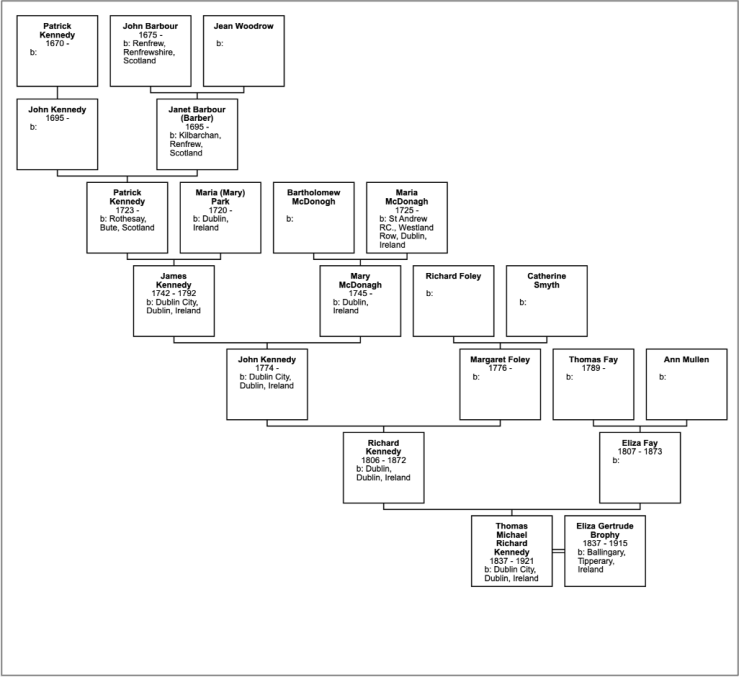
The earliest known ancestral figure in this Irish Kennedy line is Patrick Kennedy, probably born about 1720 and who lived in Dublin during his life as attested by his marriage record to Maria Park in 1742[1]. His baptismal record was not found in the surviving Irish parish registers, a silence that invites two explanations. It may reflect the gaps and losses that afflict Dublin’s eighteenth-century vital records. Yet it may also suggest that Patrick was not born in Dublin at all, but arrived there from elsewhere, as hinted by family stories of Scottish Jacobites[2]. The estimated date of his birth lends weight to this proposition. Of course, Patrick may have been born elsewhere in Ireland or have come south from Ulster however no genealogical records or DNA results have pointed in those directions to date. Therefore, the possibility of Patrick having been born in Scotland (and being the ‘original immigrant’) was further explored in the Scottish Records.
This led to a discovery in the Scottish baptismal registers of Rothesay, on the Isle of Bute in Argyll. There, in 1723, a Patrick Kennedy was born, the son of John Kennedy (seaman/fisherman) and Janet Barbour[3]. The father of John Kennedy (abt. 1695) was Patrick Kennedy (abt. 1670) also a fisherman, of Rothesay.
The Barbour Connection
Genetic data via Ancestry.com provides further evidence. A distant cousin (6-9C), CN, USA, is a DNA match with MK (author), sharing 11 centimorgans of DNA across two segments. She descends from a Robert Barbour born in Kilbarchan, Renfrew, Scotland in 1710. Barbour is the only common surname appearing between the MK and CN family trees, making the this link a likely key connection.[4] The Barbour surname was well-established in the Clyde and Bute region, and its presence in this family is striking.
Importantly, Janet Barbour was also born in Kilbarchan (in 1695) to John Barbour (merchant) and Jean Woodrow. This latter couple are referenced in the Poll tax records of Kilbarchan in 1696, tenants of the Auchinames Lands[5]. By the time of Janet Barbour’s marriage to John Kennedy in Rothesay in 1721, her father, John Barbour, was a merchant in Rothesay (30 km from Kilbarchan).
Although the MK ancestor (Janet Barbour) and the CN ancestor (Robert Barbour) were born in the same parish within less than one generation (around 1700) the precise connection between the two cannot yet be defined. It is likely that they were cousins. This genetic, geographic and time period connection is compelling evidence.
Genetic Triangulation
Subsequent to the Barbour connection between MK and CN an additional important DNA connection was discovered using the Ancestry.com cluster tools (which maps common or shared DNA connections). This revealed another MK DNA match – to GC, a distant cousin (6-9C) whose ancestors also came from Rothesay, Bute. These ancestors included Barbour family and are placed in the same towns and regions of Western Scotland during the same periods (around 1700) as the Kennedy ancestors. There are no other common surnames between MK and GC lines.
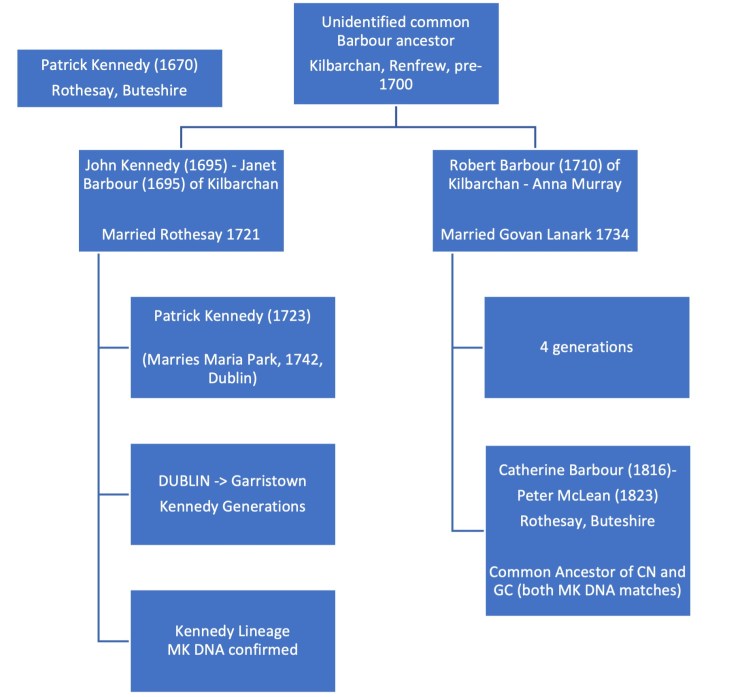
Further, a connection between CN and GC has been found – they share 34 centimorgan (cM) of DNA, and are therefore likely 4thcousins, with most recent common ancestors Peter McLean & Catherine Barbour found in Renfrewshire and Rothesay, Buteshire in the early 19th century. Robert Barbour of Kilbarchan (previous) is the 2xgreat grandfather of this common ancestor Catherine Barbour. These related individuals, CN and GC, are individually matched and related to MK (presumably through an unidentified late 17th C common ancestor in Kilbarchan).
This DNA triangulation[6] between MK, CN & GC, proves the Kennedy family presence in Rothesay, through the marriage of Janet Barbour and John Kennedy on 25 Nov 1721, and the evidence of John’s father, Patrick Kennedy (C 1670). The connection is illustrated below:
The Jacobite Tradition
Family folklore has connected the Dublin Kennedys with the Jacobite cause. This tradition, however fragmentary, is not without context. The risings of 1689–1715 drew heavily upon the Gaelic west of Scotland and the north of Ireland, regions from which the Kennedy name is descended. The defeat of the Stuart cause sent many families across the sea in search of refuge or reinvention.
Rothesay, the origin of Patrick Kennedy (1723), had in fact been occupied by Cromwellian forces from the mid 17th century, being later plundered and devastated by Archibald Campbell, 2nd Earl of Argyll in 1685, as part of a. revolt against King James VII. Through this period and later, Bute’s successful fishing industry also failed, sending many of its inhabitants elsewhere for work and livelihood. Patrick Kennedy’s father and grandfather were both fishermen/seamen.
Kilbarchan, the parish origin of the Janet Barbour family is adjacent to the Paisley Parish – which in the middle ages was a catholic parish and abbey which had considerable influence and possessions in its Kilbarchan neighbour[7]. It is very likely that both parishes harboured Jacobite sentiment and connections and thereby influenced population movement and political alignments.
Dublin also harboured pockets of Jacobite sympathy, especially among Catholic merchants and artisans. If Patrick Kennedy came to Dublin from Rothesay, he would have carried with him both the memory of Argyll—an area deeply touched by Jacobite fervour—and the experience of migration in an unsettled age. Whether or not he himself fought under the Stuart banner, his family’s movement aligns with the broader pattern of displacement in the Jacobite aftermath.
Migration Currents: Scotland, Ulster, Dublin
The pathway from Rothesay to Dublin was not unusual. The sea routes of the North Channel bound Argyll and Bute to Ulster, and from Ulster the port of Dublin lay only a further passage away. For centuries these waters had carried cattle traders, fishermen, and kinfolk; in the early eighteenth century they also bore exiles, soldiers, and settlers.
Kennedy families appear on both sides of this corridor. In Bute and Argyll, they were numerous; in Ulster, they settled among Catholic and Presbyterian communities alike; in Dublin, their name entered parish registers and trade records by the mid-eighteenth century. The Barbour families followed a similar course, their presence in Bute and Ayr mirrored in Ulster settlements. It is within this current of movement that Patrick Kennedy’s story most plausibly belongs.
The Dublin Kennedys of the 18th–19th Century
By the later eighteenth century, the Kennedy line had taken root in Dublin. Though the details of Patrick’s life remain partly obscured, his descendants were embedded in the city’s fabric. Dublin at this time was Ireland’s great urban centre, its Georgian squares and bustling markets reflecting both elegance and hardship.
Into the nineteenth century, Richard Kennedy, born about 1810, emerges from the records as a clearer figure in the line. His presence signals continuity: while many families emigrated or disappeared from the city’s rolls, the Kennedys endured. They adapted to the shifting fortunes of Dublin after the Act of Union, weathered its economic strains, and contributed to its trades and parishes. In doing so, they preserved both their name and the faint but enduring memory of Scottish origins and Jacobite ties.
The Dublin Kennedys of the eighteenth and nineteenth centuries thus stand as both inheritors and survivors: inheritors of a Scottish past tied to Bute and the western seaboard, and survivors of the shifting fortunes of Ireland’s capital through times of political change, economic strain, and social transformation.
Summary of Evidence
Y-DNA: The MK haplogroup R-Y652401 represents a rare but geographically coherent subclade of R-DF105, centred on western Scotland and Ulster. Its placement is consistent with a Kennedy origin in Rothesay, Isle of Bute, and the subsequent migration to Dublin in the early eighteenth century. The combination of genetic rarity, surname overlap, and historical migration pathways makes this haplogroup placement a valuable cornerstone in reconstructing the Kennedy family’s origins.
STR Profile: The MK STR profile shows a distinctive cluster signature (13-11-12-12-12-14 with 11-11 pairing at 455/454 and a higher DYS456 at 17) that fits securely within the DF105 > R-Y652401 branch. While not conclusive on its own, this STR pattern may serve as a useful family identifier and should be compared systematically with Kennedy project matches and potential Barbour testers. MK marker pattern provides a distinctive genetic “fingerprint” consistent with Kennedy surname clusters, potentially useful for identifying relatives in surname projects.
Autosomal DNA: The 11 cM match with a Barbour descendant from Rothesay (James Barbour, b. 1760) offers modest but meaningful support for a Kennedy–Barbour connection, especially given the Rothesay baptism of Patrick Kennedy (1723, son of John Kennedy & Janet Barbour). The match provides support for the hypothesis that Patrick Kennedy of Dublin descended from the Rothesay Kennedy–Barbour family. While the 11 cM result alone is not conclusive, its convergence with parish records and Y-DNA context makes it a valuable piece of corroborating evidence. However the triangulation offered by the GC autosomal DNA match and the GC-CN match, elevates this data to constitute proof of the relationship and geographic origin.
Documentary Records: A Patrick Kennedy born in Rothesay to John Kennedy and Janet Barbour (1723) provides a plausible candidate for the Dublin ancestor. Dublin records lack a baptism for Patrick Kennedy, consistent with record loss or external origin. Migration and trade routes between Argyll/Bute and Dublin provide a historically plausible pathway. The family tradition of Jacobite sympathies is consistent with the historical context of both Argyll and Dublin in the early eighteenth century
Overall:
The combined genetic, documentary, and historical evidence provides a coherent hypothesis for the Kennedy origins to the point of ‘genealogical proof’. While minor genetic data gaps remain, the convergence of Rothesay records, Barbour DNA connections, and the R-Y652401 haplogroup placement provides essentially definitive research.
The hypothesis that Patrick Kennedy of Dublin (1723) originated in Rothesay, Isle of Bute, as the son of John Kennedy and Janet Barbour is highly credible, providing conclusive support for ancestral Scottish roots for the family of Thomas Kennedy of Linton.
Thomas’s memory of his grandfather’s words recounting “that the family fled (Scotland) as Jacobites to take refuge with friends and family in Ireland” to become “faux Irish” appears accurate.
[1] National Library of Ireland; Dublin, Ireland; Irish Catholic Parish Registers; Microfilm Number: 07138 / 01
[2] Verbal History: reliably attributed to the grandfather of Thomas Kennedy (1837) of Linton
[3] In the records of the 16-1700s, the Barbour surname is spelt variously Barbour (correctly), Barbor, Barber
[4] https://www.ancestry.com.au/family-tree/tree/68203714/family/pedigree?cfpid=38175462237
[5] Kilbarchan A Parish History, MacKenzie Robert D, 1902, Pub Paisley: Alexander Gardner, Pg 140
[6] Current research to establish the precise chromosomal segment matches in this triangulation has commenced. This may provide further corroboration or may contribute no further useful evidence depending on precise segment matches between the 3 individuals.
[7] Kilbarchan A Parish History, MacKenzie Robert D, 1902, Pub Paisley: Alexander Gardner, Chapter 3 Kilbarchan in Roman Catholic Times, pp 11-28.
 marcuskennedy.net